
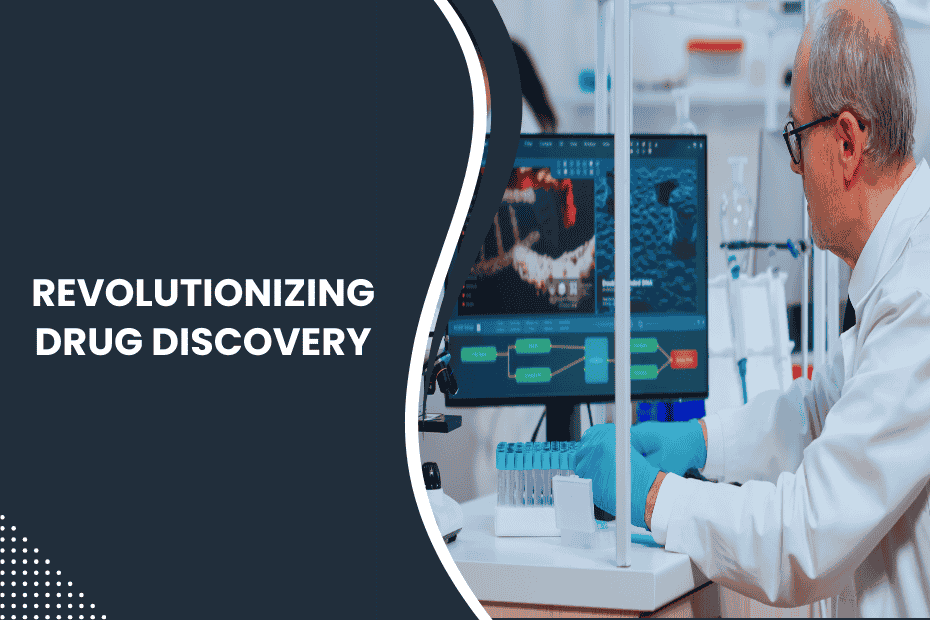
The process of drug discovery has always been complex, time-consuming, and expensive, often taking over a decade and costing billions of dollars to bring a single drug to market. However, artificial intelligence (AI) is transforming this process by dramatically speeding up the identification of new drugs, reducing costs, and enhancing accuracy. Let’s explore how AI is revolutionizing drug discovery and reshaping the future of medicine.
Accelerating Target Identification
One of the earliest stages in drug discovery is identifying biological targets, such as proteins or genes, that play a key role in disease. Traditionally, this process relied on slow laboratory experiments. With AI, researchers can analyze vast datasets, including genomic and proteomic data, to rapidly identify potential drug targets. AI tools like machine learning (ML) algorithms analyze the structure and function of proteins, dramatically speeding up this process.
For example, AI-based tools like AlphaFold have revolutionized protein structure prediction, which is crucial for designing new drugs. This ability to quickly predict the structure of proteins helps researchers understand disease mechanisms and identify targets that may not have been previously considered. As a result, AI can shorten the early stages of drug discovery from years to just months.
Enhanced Drug Screening and Virtual Testing
Once a target has been identified, the next step is screening potential drug compounds that could interact with the target. Traditionally, this involved testing thousands of compounds in a lab, which is time-consuming and expensive. AI changes this by allowing for virtual screening, where machine learning models predict which compounds are most likely to be effective based on their molecular structure.
AI algorithms can analyze chemical properties and molecular interactions much faster than traditional methods, enabling researchers to screen large libraries of compounds in a fraction of the time. This will speed up the discovery process and reduce the need for expensive laboratory tests.
AI-Driven Drug Design
Beyond identifying potential drugs, AI is also being used to design new molecules from scratch. Generative models in AI can create entirely new drug molecules by analyzing chemical structures and predicting which configurations are most likely to bind to the target. This innovation allows researchers to generate novel drug candidates that may not exist in nature.
AI-driven drug design is particularly useful for diseases that have proven difficult to treat with conventional methods, such as cancer or rare genetic disorders. The ability to generate and optimize molecules based on desired properties, such as potency or reduced toxicity, gives pharmaceutical companies a powerful tool for developing highly specific therapies.
Optimizing Clinical Trials
AI is also transforming the clinical trial phase, which is one of the most time-consuming and expensive parts of drug development. AI can optimize patient selection for trials by analyzing patient data and identifying those most likely to benefit from a new drug. This leads to more effective trials with higher success rates.
Additionally, AI can monitor clinical trial data in real-time, allowing for quicker adjustments to dosage, treatment protocols, or trial design. This reduces the time it takes to complete trials and improves the chances of a drug making it to market.
Reducing Time to Market
AI’s ability to accelerate multiple stages of drug discovery and development means that life-saving drugs can reach the market faster. In some cases, AI has reduced the time to develop a drug from over a decade to just a few years. This will benefit patients who are waiting for new treatments but also significantly reduces the costs associated with drug development.
Personalized Medicine
One of the most promising aspects of AI in drug discovery is its potential to drive personalized medicine. AI can analyze individual genetic profiles and predict how different people will respond to certain drugs. This means that treatments can be tailored to individual patients, increasing the chances of success and minimizing side effects.
By leveraging AI, pharmaceutical companies can move away from the one-size-fits-all approach and develop treatments that are more precise and effective for each patient, particularly in areas like oncology and autoimmune diseases.
Tackling Rare and Complex Diseases
AI is opening up new possibilities for treating rare diseases and complex conditions that have previously been difficult to target. Traditional drug discovery methods often overlook rare diseases due to the high costs and low return on investment. However, AI allows researchers to explore new approaches for targeting these diseases, often identifying treatments that may have been missed using conventional methods.
AI is also helping to repurpose existing drugs for new uses. By analyzing vast datasets of clinical trials and patient outcomes, AI can identify new applications for drugs that are already on the market, potentially speeding up the development of treatments for rare or difficult-to-treat conditions.
Key AI Innovations in Drug Discovery
- Target Identification: AI helps pinpoint biological targets faster and with greater accuracy.
- Virtual Screening: Machine learning accelerates the screening of drug compounds, reducing the need for physical testing.
- Drug Design: AI generates new molecules with optimal properties for treating diseases.
- Clinical Trial Optimization: AI improves patient selection and real-time trial adjustments, leading to more efficient trials.
- Personalized Medicine: AI tailors treatments to individual patients based on genetic data, enhancing treatment efficacy.
In Conclusion
AI is reshaping the drug discovery process, making it faster, more efficient, and cost-effective. By leveraging AI, pharmaceutical companies can innovate more rapidly, bringing new and life-saving treatments to market in less time. The potential of AI in drug discovery is only beginning to be realized, and as the technology continues to advance, we can expect even greater breakthroughs in medicine that will benefit millions of people worldwide.

Vittorio Di Criscio is a tech entrepreneur and investor with over two decades of experience building and scaling online ventures since the dot-com era. He focuses on digital transformation and early-stage technology investments, and is an active philanthropist supporting education, technology, and entrepreneurship while mentoring emerging founders.