
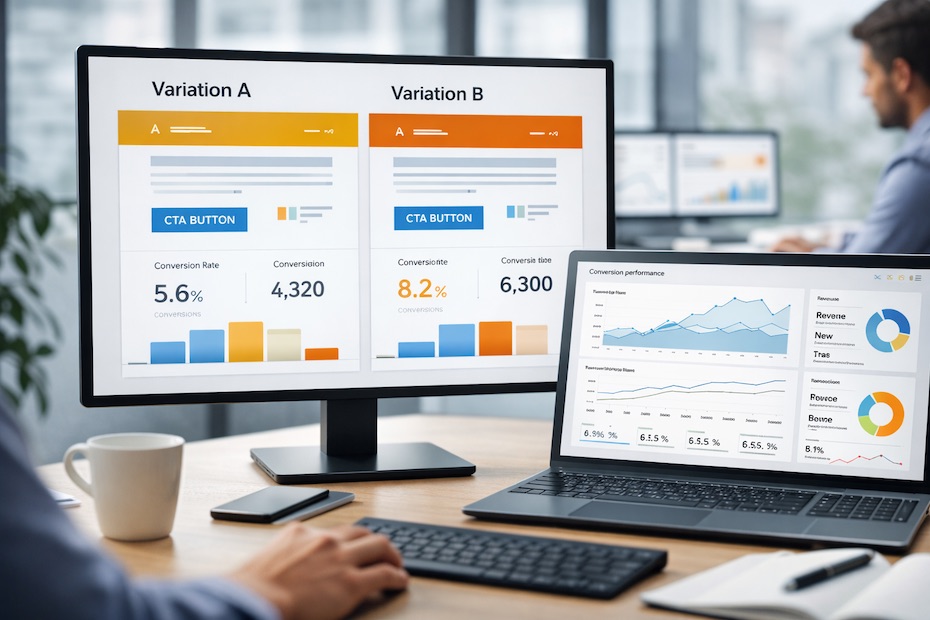
A/B testing tools help you compare campaign variations using real user behavior so you can improve conversions, engagement, and revenue with confidence. When you rely on the right tools, decisions shift from opinion-driven debates to repeatable, measurable outcomes.
This article walks you through ten essential tools for A/B testing your marketing campaigns, grounded in how modern marketing teams actually test landing pages, ads, emails, and digital experiences today. You’ll see what each tool does best, where it fits operationally, and how experienced marketers combine them to build a disciplined testing program that scales.
Tool 1: Optimizely — Enterprise Experimentation Across Web and Product
Optimizely is often the first name that comes up when teams ask which A/B testing platform supports serious experimentation programs. It enables controlled tests across web experiences, product features, and even backend logic.
You use Optimizely when experiments affect core revenue flows like pricing pages, checkout paths, or onboarding. The platform supports complex targeting, feature flagging, and detailed reporting that large teams require to coordinate tests across departments.
Marketing leaders value Optimizely because it supports governance. Permissions, approval workflows, and experiment history reduce risk while allowing teams to test continuously without breaking production environments.
Tool 2: VWO — Conversion Optimization Built for Marketing Teams
VWO focuses on conversion rate optimization with a toolset that blends A/B testing, heatmaps, and session recordings. This makes it a strong option when marketing teams want testing power without constant engineering support.
You can test headlines, layouts, forms, and calls to action using visual editors. Behavior data helps explain why one variant outperforms another, which strengthens future hypotheses.
VWO fits organizations where speed matters. You move from idea to live test quickly while still maintaining statistical rigor and clear performance reporting.
Tool 3: Adobe Target — Personalization and Testing at Scale
Adobe Target is built for organizations that run both personalization and experimentation programs. It allows you to test variations while delivering tailored experiences to different audience segments.
You can experiment across web, mobile, and email journeys while applying rules based on behavior or attributes. This enables structured testing even inside personalized funnels.
Adobe Target works best when teams already operate within the Adobe marketing ecosystem and manage large volumes of data across multiple channels.
Tool 4: AB Tasty — Experience Testing With Personalization Controls
AB Tasty blends A/B testing with experience optimization. Teams use it to test visual changes, messaging, and layouts while layering in personalization rules.
You can segment users based on traffic source, device, or behavior and run controlled experiments within those segments. This supports smarter optimization without sacrificing clarity in results.
AB Tasty suits growth-focused teams that want experimentation tightly connected to user experience design and engagement metrics.
Tool 5: Convert — Privacy-Focused A/B Testing With Performance Stability
Convert appeals to teams that prioritize fast load times and clean experiment data. It emphasizes lightweight scripts and privacy-friendly testing practices.
You use Convert to test landing pages, navigation, copy, and offers without introducing noticeable performance overhead. This matters when speed directly affects conversion rates.
Convert is often selected by SaaS and content-driven businesses that want reliable experimentation without unnecessary complexity.
Tool 6: Kameleoon — AI-Assisted Testing and Experiment Targeting
Kameleoon combines A/B testing with AI-driven targeting and experimentation recommendations. It supports both client-side and server-side testing.
Marketing and product teams use Kameleoon to identify which segments respond best to specific changes. This improves test efficiency by focusing effort where impact is highest.
Kameleoon fits organizations running advanced testing programs that require experimentation across web and application layers.
Tool 7: Google Ads Experiments — Controlled Testing for Paid Campaigns
Google Ads includes built-in experimentation features that allow you to test campaign variations safely. You compare bidding strategies, creatives, and audience targeting under controlled conditions.
You define experiment splits and durations directly inside the platform. Performance comparisons reflect real ad delivery rather than simulated projections.
This tool is essential when paid media represents a large share of acquisition spend and changes carry immediate budget impact.
Tool 8: Google Analytics 4 — Measurement That Validates Test Outcomes
Google Analytics 4 does not run experiments, but it plays a central role in A/B testing programs. You use it to analyze downstream behavior tied to each test variant.
GA4 helps confirm whether winning versions improve meaningful metrics like revenue, retention, or funnel completion rather than surface-level clicks.
Experienced marketers rely on GA4 to connect experiment results to broader business performance across channels.
Tool 9: Microsoft Clarity — Behavioral Data That Explains Results
Microsoft Clarity supports A/B testing programs by showing how users interact with test variants. Heatmaps and session recordings reveal friction points clearly.
You use Clarity to validate assumptions behind test results. When Variant B wins, Clarity helps you understand which elements changed user behavior.
This tool strengthens experimentation programs by improving hypothesis quality rather than replacing testing platforms.
Tool 10: Mailchimp A/B Testing — Practical Testing for Email Campaigns
Mailchimp provides built-in A/B testing for email subject lines, content, and send times. This makes it a practical choice for lifecycle and newsletter marketing.
You compare open rates, click-through rates, and conversions automatically. Results feed directly into future campaign planning.
Mailchimp’s testing features suit teams that want reliable email experimentation without managing separate tools.
Which A/B Testing Tool Replaces Google Optimize?
Many marketers ask which tool replaces Google Optimize after its shutdown. The answer depends on testing depth and technical resources.
For simple web experiments, platforms like VWO, Convert, or AB Tasty cover most needs. For advanced experimentation across product and backend logic, Optimizely or Kameleoon provide greater control.
The key shift is recognizing that GA4 supports measurement, not experimentation. Dedicated testing platforms now handle execution.
How Long Should You Run an A/B Test to Trust the Results?
A/B tests should run long enough to capture stable behavior patterns across full business cycles. Short tests risk misleading conclusions due to random variation.
Experienced teams define duration in advance based on traffic volume, baseline conversion rates, and decision urgency. This discipline prevents premature test termination.
Ending tests based on early results often leads to reversals when additional data arrives.
Common Errors That Undermine Marketing Experiments
Testing too many variables at once weakens conclusions. Clear experiments isolate changes so results remain interpretable.
Stopping tests early remains another frequent issue. Short-term spikes often flatten with time.
Disconnecting tests from business metrics also reduces value. Experiments should link directly to revenue, qualified leads, or retention.
Best A/B Testing Tools for Marketing
- Web and product testing: Optimizely, VWO, Convert
- Personalization and experience: Adobe Target, AB Tasty
- Email and ads: Mailchimp, Google Ads Experiments
- Behavioral analysis: Microsoft Clarity
Turn Testing Into a Growth Discipline
A/B testing becomes valuable when it operates as a system rather than a series of one-off experiments. The tools in this guide support every stage of maturity, from basic email tests to enterprise-level experimentation across products and channels. Your role is to choose tools that match how fast decisions move and how deeply changes affect revenue. When testing integrates cleanly with analytics and execution, marketing performance improves with less friction. That consistency is what separates reactive optimization from sustained growth.

Vittorio Di Criscio is a tech entrepreneur and investor with over two decades of experience building and scaling online ventures since the dot-com era. He focuses on digital transformation and early-stage technology investments, and is an active philanthropist supporting education, technology, and entrepreneurship while mentoring emerging founders.