
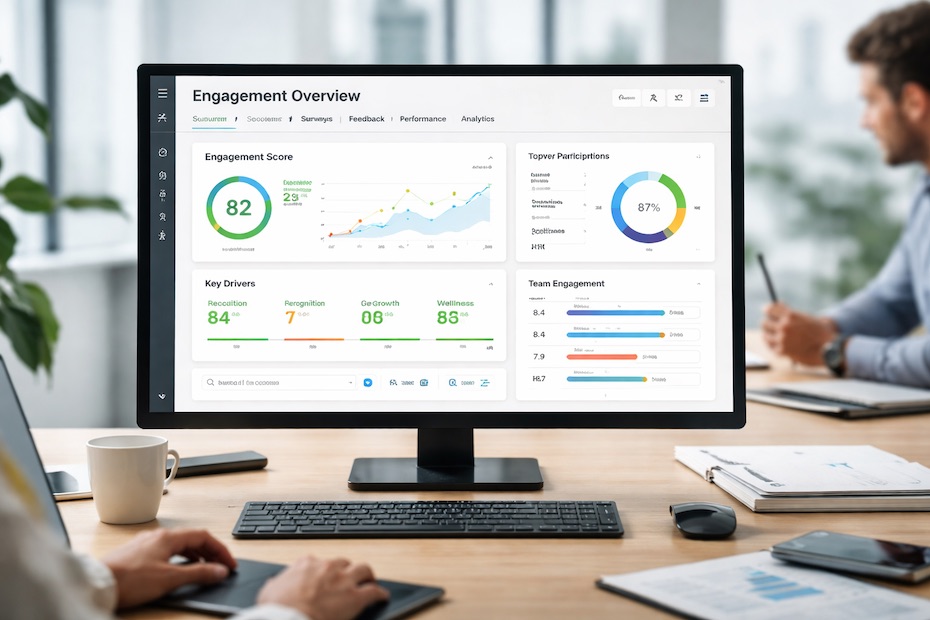
Employee engagement and feedback software gives you structured, measurable ways to understand how your people experience work and how leadership decisions land on the ground. The right tools replace guesswork with continuous signals, allowing you to improve retention, performance, and manager effectiveness with speed and precision.
This guide breaks down the five platforms consistently rated highest by HR leaders and operators who manage engagement at scale. You’ll see how each solution works, where it fits best, and how to choose based on real operating needs rather than feature checklists.
Solution 1: Lattice — Engagement Connected Directly to Performance
Lattice positions employee engagement as something inseparable from performance management. You use the platform to run engagement surveys, manage goals, conduct reviews, and structure one-on-ones inside a single system. That unified setup matters when you want feedback to lead to action rather than sit in dashboards.
Engagement surveys inside Lattice tie directly to team objectives and individual goals. When sentiment dips, managers can see how workload, clarity, or recognition intersects with performance data. This removes the common gap between “people feedback” and “business priorities” that slows decision-making in many organizations.
Lattice works especially well in companies where managers own engagement outcomes. Survey results surface at the team level, prompting structured follow-ups during one-on-ones. This design supports accountability without creating fear or survey fatigue, which keeps participation rates steady over time.
Solution 2: Leapsome — Continuous Feedback and Employee Development
Leapsome focuses on engagement through growth, feedback, and skill development. You deploy pulse surveys, 360-degree feedback cycles, and engagement diagnostics while connecting results to learning paths and career progression. This approach resonates strongly in fast-growing teams.
Feedback in Leapsome flows in multiple directions. Peers, managers, and direct reports contribute input in structured cycles, giving employees a clearer picture of how their work shows up across the organization. This level of transparency supports trust and sustained engagement.
Leapsome stands out when engagement challenges relate to development or progression rather than compensation or workload alone. Survey insights link directly to learning modules, enabling you to respond to feedback with targeted upskilling instead of generic initiatives that rarely move engagement scores.
Solution 3: 15Five — High-Frequency Check-Ins That Managers Actually Use
15Five centers engagement around consistent manager-employee communication. Weekly check-ins, short pulse surveys, and priority tracking create a rhythm that keeps sentiment visible without overwhelming teams. The design favors simplicity and speed over complex configuration.
Managers use 15Five to gather weekly signals on morale, blockers, and workload. This cadence allows issues to surface early, long before annual surveys would catch them. Engagement becomes part of everyday operations rather than a quarterly HR project.
Organizations with distributed or hybrid teams often adopt 15Five because it keeps communication structured without adding meetings. Engagement data stays current, managers stay informed, and employees feel heard on an ongoing basis rather than during isolated survey windows.
Solution 4: Officevibe — Fast Pulse Surveys With Clear Manager Guidance
Officevibe specializes in pulse surveys that employees complete quickly and consistently. The platform emphasizes ease of participation, which helps maintain response rates even in frontline or high-tempo environments.
Survey results in Officevibe display as trend lines, heat maps, and focus areas. Managers receive coaching prompts tied to specific engagement drivers, guiding them toward practical next steps instead of leaving interpretation to chance.
This solution fits well when you need engagement visibility across large teams with limited HR bandwidth. Officevibe removes complexity while still delivering meaningful signals managers can act on without extensive training or analytics expertise.
Solution 5: Culture Amp — Engagement Analytics and Benchmarking at Scale
Culture Amp approaches employee engagement with the same rigor many organizations apply to financial or operational data. The platform combines engagement surveys, lifecycle feedback, and benchmarking against industry data.
You gain visibility into how engagement varies by role, tenure, location, or team. This segmentation allows leadership to prioritize interventions where they matter most rather than relying on company-wide averages that mask underlying issues.
Culture Amp suits organizations that view engagement as a strategic lever. The analytics depth supports workforce planning, retention strategies, and leadership development, especially in companies operating across multiple regions or business units.
What to Look for When Comparing Employee Engagement Software
Choosing engagement software starts with clarity on what you want to improve. Some tools emphasize frequent feedback, while others prioritize analytics depth or integration with performance systems. Matching the platform to your operating model matters more than feature volume.
Consider how managers will use the data. Platforms that surface insights directly inside one-on-ones or check-ins tend to drive faster action. Tools that require heavy interpretation often stall, even when the data itself is strong.
Integration also plays a critical role. Engagement platforms that connect smoothly with your HRIS, collaboration tools, and performance systems reduce friction and increase adoption across teams.
How Often Should You Measure Employee Engagement?
Most high-performing organizations move away from annual surveys toward shorter, recurring pulses. Monthly or quarterly engagement checks capture shifts in sentiment without creating fatigue when questions remain focused and relevant.
High-frequency tools like weekly check-ins work best when surveys stay brief and managers respond visibly. Employees disengage quickly when feedback disappears into reports without follow-up.
The right cadence depends on organizational pace. Fast-moving teams benefit from more frequent signals, while stable environments may rely on quarterly engagement tracking supplemented by ongoing feedback channels.
How Engagement and Feedback Software Improves Retention
Engagement platforms improve retention by identifying issues early and enabling targeted responses. When employees see leadership respond to feedback with concrete changes, trust strengthens and voluntary turnover declines.
Patterns in engagement data often predict attrition risk. Drops in recognition, clarity, or manager support frequently appear weeks or months before employees exit. Software makes those signals visible while there is still time to intervene.
Retention improves further when engagement insights inform manager coaching. Leaders equipped with clear feedback address problems directly instead of relying on assumptions or delayed exit interviews.
Common Mistakes Companies Make With Engagement Tools
A frequent mistake is collecting feedback without assigning ownership. Engagement data only creates value when managers and leaders act on it consistently.
Another issue arises when surveys are too long or too frequent without purpose. Over-surveying erodes trust and reduces response quality, even with strong software.
Companies also struggle when engagement platforms operate separately from performance or development systems. Disconnected tools slow action and dilute accountability across teams.
Best Employee Engagement Software
- Top tools: Lattice, Leapsome, 15Five, Officevibe, Culture Amp
- Core uses: pulse surveys, feedback, engagement analytics
- Best for managers: 15Five, Officevibe
- Best for analytics: Culture Amp
Turn Engagement Data Into Leadership Advantage
Employee engagement and feedback software only delivers value when it strengthens daily leadership decisions. The platforms in this guide give you different paths to that outcome, from high-frequency check-ins to advanced analytics and benchmarking. Your role is to align the tool with how managers lead, how teams communicate, and how quickly decisions move from insight to action. When engagement data informs real conversations and real changes, culture improves without guesswork. That is where these solutions earn their place in your operating stack.

Vittorio Di Criscio is a tech entrepreneur and investor with over two decades of experience building and scaling online ventures since the dot-com era. He focuses on digital transformation and early-stage technology investments, and is an active philanthropist supporting education, technology, and entrepreneurship while mentoring emerging founders.